

November 5, 2026
Listen to full episode :
An AI model can explain customer lifetime value, describe a marketing framework, and generate a plausible recommendation. That still leaves the person using it with a difficult task: deciding whether the recommendation fits the problem they have.
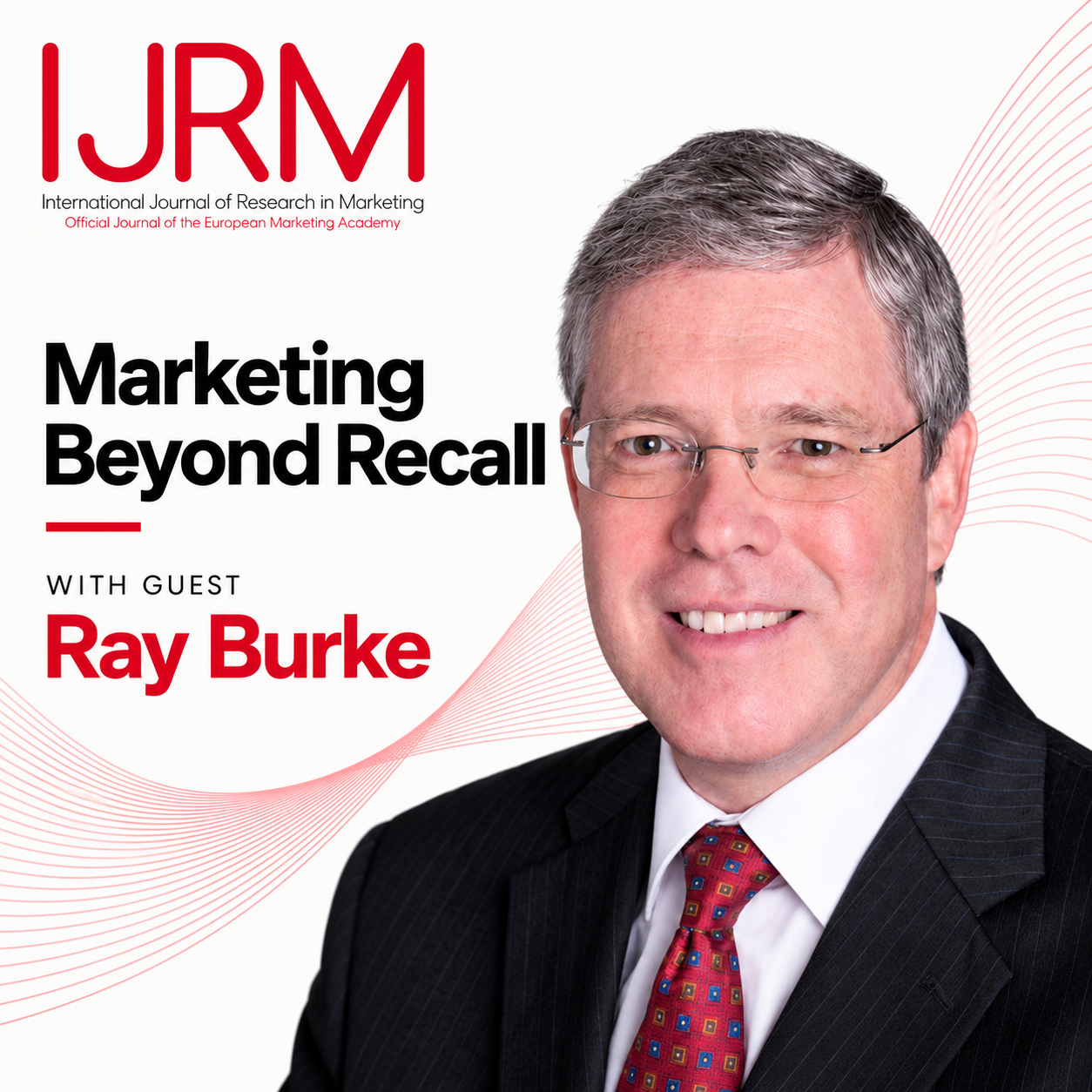
In this episode of Up Next, Ray Burke, E.W. Kelly Professor of Business Administration at Indiana University’s Kelley School of Business, joins us to discuss research published in the International Journal of Research in Marketing with Max Matthe and Alex Leykin. They examined how accurately general AI models hold and use the foundational knowledge taught in marketing courses.
The models performed strongly on recall and understanding. Their performance fell as questions required more complex reasoning. Our conversation explores what that means for practitioners and for the people learning to become practitioners:
Knowing a framework and applying it are different tasks. A strong overall score can obscure weaknesses in application, analysis, and evaluation. Those are precisely the capabilities a marketer needs when weighing a business decision.
A flawed premise can survive the conversation. Burke describes a gap between confirming true statements and recognizing false ones. If a user brings an incorrect assumption, the model may reinforce it. Asking for alternative explanations and critiques gives the user more to evaluate.
Problem framing remains part of the work. Burke recommends providing objectives and context, then asking the model to examine a problem through multiple frameworks. Marketing often permits several defensible approaches; the user still must assess which fits the available evidence.
Shared tools make company knowledge more important. Competitors can access the same general models. Proprietary understanding of customers, channels, and market conditions helps a company evaluate generic advice and develop an approach grounded in its own circumstances.
Physical shopping exposes limits in synthetic consumers. A response to a verbal prompt does not necessarily predict behavior in a store. Burke points to the effects of fatigue, shelf height, and even a squeaky shopping cart as examples of experiences a model may not capture.
Junior marketers need opportunities to develop judgment. Drafting briefs, building models, and working through rejected ideas have traditionally provided practice. We discuss how case studies, simulations, and feedback might help preserve learning as AI takes on more of that work.
Burke describes a process with human involvement at both ends: framing the problem before using AI and evaluating the recommendations afterward. The quality of the result depends on the knowledge and judgment brought to both tasks.
Click here for the Research Article
The Up Next podcast’s access to this content is courtesy of the International Journal of Research in Marketing, an international, double-blind peer -reviewed journal for marketing academics and practitioners. IJRM aims to contribute to the marketing discipline by providing high-quality, original research which advances marketing knowledge and techniques. As marketers increasingly draw on diverse and sophisticated methods, IJRM‘s target audience is comprised of marketing scholars, practitioners (e.g., marketing research and consulting professionals) and policymakers.
IJRM aims to be at the forefront of the marketing field with a particular emphasis on bringing timely ideas to market. The journal embraces innovative research with the potential to spur future research and influence practice. Hence, it welcomes contributions in various aspects of marketing. The editors, while accepting a wide array of scholarly contributions from different disciplinary approaches, especially encourage research that is novel, visionary or path breaking.
Interviewee
Dr. Raymond R. Burke is the E.W. Kelley Chair and Professor of Marketing at Indiana University’s Kelley School of Business, where he is the founding director of the Customer Interface Laboratory, a state-of-the-art facility for studying how consumers interact with retail environments and emerging technologies. A pioneer in shopper marketing and virtual shopping research, his work examines how store design, merchandising, pricing, packaging, and other point-of-purchase factors shape consumer attention, decision-making, and purchasing behavior. His scholarship has appeared in leading publications, including Harvard Business Review, Journal of Consumer Research, Journal of Marketing, Journal of Marketing Research, and Marketing Science. Before joining Indiana University, Dr. Burke served on the faculties of the Harvard Business School and the Wharton School of the University of Pennsylvania. Recognized by Poets & Quants as one of the world’s best business-school professors, he is also an accomplished educator and industry advisor whose virtual shopping technologies have supported market research applications around the world.
Co-Authors
Dr. Max Matthe is an Assistant Professor of Marketing at Indiana University’s Kelley School of Business and an affiliate of its Advanced Business Technologies Department. His research lies at the intersection of quantitative marketing and modern data science, with particular emphasis on market structure, competitive positioning, brand strategy, and the evolving role of technology in marketing. Drawing on machine learning, natural language processing, psychometrics, and causal inference, he develops innovative approaches to complex managerial challenges in segmentation, targeting, positioning, and competitive analysis while also investigating the implications of emerging technologies, including large language models, for marketing practice. His research has been published in Marketing Science and the International Journal of Research in Marketing, and he has received international recognition for his work on mapping the evolution of market structure. Dr. Matthe earned his Ph.D. in Marketing from Goethe University Frankfurt and received the Kelley School’s Trustees Teaching Award for his contributions to marketing analytics education.
Dr. Alex Leykin is a computer scientist, artificial intelligence researcher, and educator whose career bridges academic inquiry with applied data innovation. At Indiana University, he serves as a research associate in the Kelley School of Business’s Customer Interface Laboratory and as an adjunct lecturer in computer science and informatics, applying computer vision, machine learning, eye tracking, and behavioral analytics to research on consumer attention, shopper behavior, and human activity. He earned his Ph.D. in Computer Science from Indiana University, building on graduate training in computer science and applied mathematics, and has contributed to interdisciplinary research spanning visual tracking, multimodal sensing, image analysis, and retail marketing. As a researcher with Data Belay, Dr. Leykin brings this breadth of academic and technical expertise to data-centered innovation and the practical application of advanced computational methods.
Follow and learn more:
International Journal of Research in Marketing
Ray Burke
Max Matthe
Alex Leykin